Asia
Lane is Available
Export and Import to Taiwan
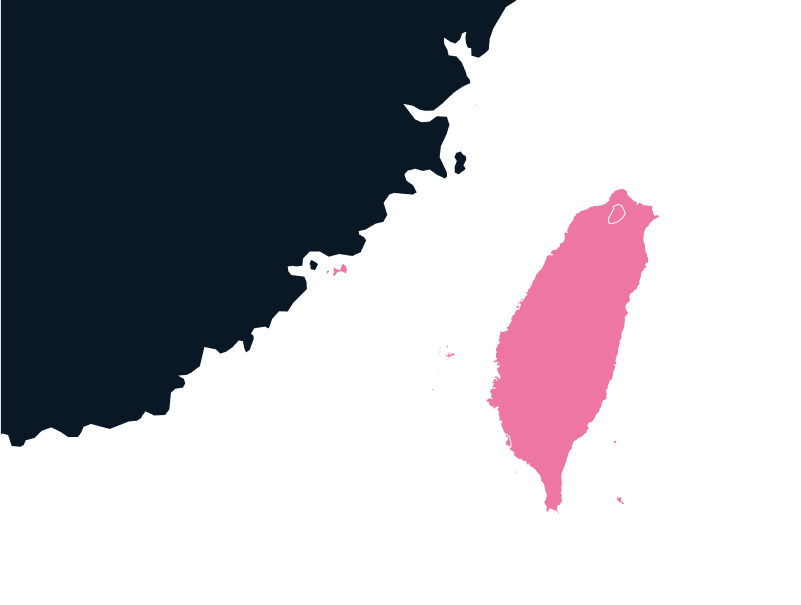
Taiwan remains one of the most advanced economies in Asia, driving innovation in AI and telecommunications. Renowned for its cutting-edge technology industries, Taiwanese shippers are facing a dual reality: unprecedented tariff reductions for US-linked trade with aggressive export controls on semiconductors and quantum computing.
Tax
Up to 5%

Duties
Up to 12%

Lead Times
5-6 Weeks

Restricted Items
Wireless Goods, Certain Goods of Chinese Origin and OEM Restrictions

Best Carrier Option
Courier or Freight Forwarder

Non-Working Days
Saturday, Sunday, and Public Holidays

Prominent Languages
Taiwanese Mandarin, Taiwanese Hokkien and Hakka
Importing to Taiwan
Importing to Taiwan can be a complex process, largely due to the country’s strict regulations and import controls, especially for high-tech products and dual-use technology. These requirements can make the importation of certain goods more challenging, as you must adhere to various documentation, clearance, and compliance standards.
In terms of customs clearance, the process is usually straightforward for most goods, but items subject to special regulations may face additional scrutiny. It’s also important to note that all required documentation must be submitted in Chinese to avoid delays in processing.
Population
23.28 M
Biggest Industry by Export
Semiconductors and Electronic Components
Capital City
Taipei City
Biggest Industry by Import
Machinery and Electrical Equipment
This includes a commercial invoice that must include the Incoterm, insurance, freight costs, and any applicable discounts or commissions. A Bill of Lading or Airway Bill is required for shipping, while a packing list is needed if the shipment consists of more than 2 cartons.
Taiwan’s National Security and N-1 Principles
Products from mainland China are subject to prohibition, including certain food items and medical equipment. Taiwan also restricts the importation of items intended for military use and other products that could impact national security.
Taiwanese compliance now includes stricter intangible controls for tech firms that have manufacturing hubs in the country. While not always codified in law, authorities are enforcing the “N-1” rule during investment reviews. This is in efforts to ensure that technology exported or manufactured overseas (specifically in China) remains at least one generation behind tech produced and deployed in-land.
New amendments to data privacy laws also require ecommerce and tech platforms to report any data breaches within 72 hours.
Additionally, products that fall under Taiwan’s safety and conformity assessment regulations must undergo testing or certification before they can be imported. This includes electrical products that may require electromagnetic compatibility (EMC) inspection.
Import Compliance Pain Points and Challenges for Taiwan
Strict Import Controls
Taiwan’s import regulations are stringent, particularly for technology goods. The government actively protects its domestic tech industry, and businesses may face delays due to the need for special permits and compliance checks.
Complex Customs Procedures
Even though most goods do not require an import permit, the customs clearance process can be complicated due to strict product specifications, value assessments, and product-specific rules.
Non-Tariff Barriers
While Taiwan has relatively low tariffs, it uses non-tariff barriers like safety standards, testing, and product conformity certifications, which can significantly delay the import process.
Language Barriers:
Most documents for customs clearance must be submitted in Chinese. For businesses unfamiliar with the language, this can cause delays and increase the risk of non-compliance.
Countries Associated with Taiwan
Asia
Japan
Asia
South Korea
Export Requirements for Taiwan
As a key player in the global electronics, semiconductor, and technology markets, Taiwan has clear and well-structured export regulations to navigate. One of the primary requirements for exporting goods from Taiwan is the need for export licenses and permits. Additionally, some products are subject to export controls to ensure that Taiwan complies with international agreements and regulations, which adds another layer of complexity to the export process.
Depending on the product, a certificate of origin may also be required, particularly for goods that fall under trade agreements, such as those with New Zealand and Singapore. Products subject to these agreements must be properly documented to ensure compliance.
Taiwan enforces stringent export restrictions and controls on products like semiconductors and AI hardware, which are often subject to international restrictions or licensing requirements.
Additionally, goods that fall under international arms treaties or other sensitive categories are subject to specific export restrictions that must be adhered to, requiring businesses to stay informed about the latest regulatory changes and compliance requirements.
Strategic High-Tech Commodities (SHTC) Permit
Taiwan’s Ministry of Economic Affairs has added 18 high-tech items to its strategic control list. If you ship any of these items, including semiconductors, quantum computing, 3D printing equipment, or products from certain OEMs, a Strategic High-Tech Commodities (SHTC) Permit is now required.
Specialized Taiwanese Solutions and Services
We offer support for obtaining special permits required for dual-use goods, ensuring compliance with Taiwan’s safety and environmental standards, and offering Delivered Duty Paid (DDP) solutions. These DDP solutions cover every aspect of customs clearance and importation, making the process smoother and more efficient for businesses.
For businesses concerned with meeting Taiwan’s regulatory and documentation requirements, TecEx also offers compliance and certification support, ensuring compliance with specific regulations, such as Taiwan’s electromagnetic compatibility (EMC) standards. These services reduce the risk of delays and help ensure compliance with both local and international regulations.
Lastly, we offer Importer of Record (IOR) and Exporter of Record (EOR) services. TecEx can act as the IOR or EOR for companies without a physical presence in Taiwan, taking on the responsibility of ensuring full import/export compliance. This is beneficial for those looking to enter the Taiwanese market without establishing a local office or subsidiary.
Taiwanese Compliance Regulations
Taiwan enforces strict compliance regulations, particularly in sectors such as electronics, chemicals, and pharmaceuticals. Key compliance regulations include:
Customs Procedures
The Taiwan Customs Administration oversees the enforcement of import/export regulations. Businesses must ensure all customs declarations are accurate and complete to avoid delays.
Product Safety Standards
Products in categories like home appliances, electrical devices, and telecommunication goods must meet safety and electromagnetic compatibility (EMC) standards set by the Bureau of Standards, Metrology and Inspection (BSMI).
Environmental Compliance
Products must comply with Taiwan’s environmental regulations, which are in line with international norms, such as the International Electrotechnical Commission (IEC) standards.
Trade Agreements
Taiwan has signed several Free Trade Agreements (FTAs) with countries such as Panama, El Salvador, and Honduras. These agreements often allow for reduced tariffs or duty-free access for certain goods.
Regarding tariffs and duties, the average nominal tariff rate for industrial products is 4.16%. Taiwan utilizes the Harmonized Commodity Description and Coding System (HS Code) for product classification, which aligns with international standards.
Taiwan’s Trade Landscape
Taiwan plays a crucial role in the global supply chain, particularly in the semiconductor market, where it is home to Taiwan Semiconductor Manufacturing Company (TSMC), the world’s largest independent semiconductor foundry. The nation’s technological expertise extends to other areas, such as printed circuit boards, LCD panels, and optical devices.
Taiwan’s economy is export-driven, with major trading partners including China, the United States, Japan, and the European Union. Taiwan benefits from several FTAs, although its agreements are somewhat limited due to domestic security and economic concerns.
Taiwan’s strong position in global trade, particularly in technology and electronics, comes with a highly structured and stringent regulatory environment for imports and exports. While the country’s customs procedures are well-established, they can be complex, particularly for high-tech and dual-use products. By partnering with a specialized trade compliance provider like TecEx, businesses can navigate Taiwan’s import/export landscape more efficiently, ensuring compliance, reducing delays, and optimizing their supply chain operations.
Important Dates
Apart from the the nation’s public holidays, it is important to note that the Taiwanese usually close up shop for Chinese New Year which typically falls between January and February.
Ready to Export or Import to Taiwan?
Ship your tech goods to Taiwan with TecEx as your expert compliance partners. Reach out today for a tailored solution.